
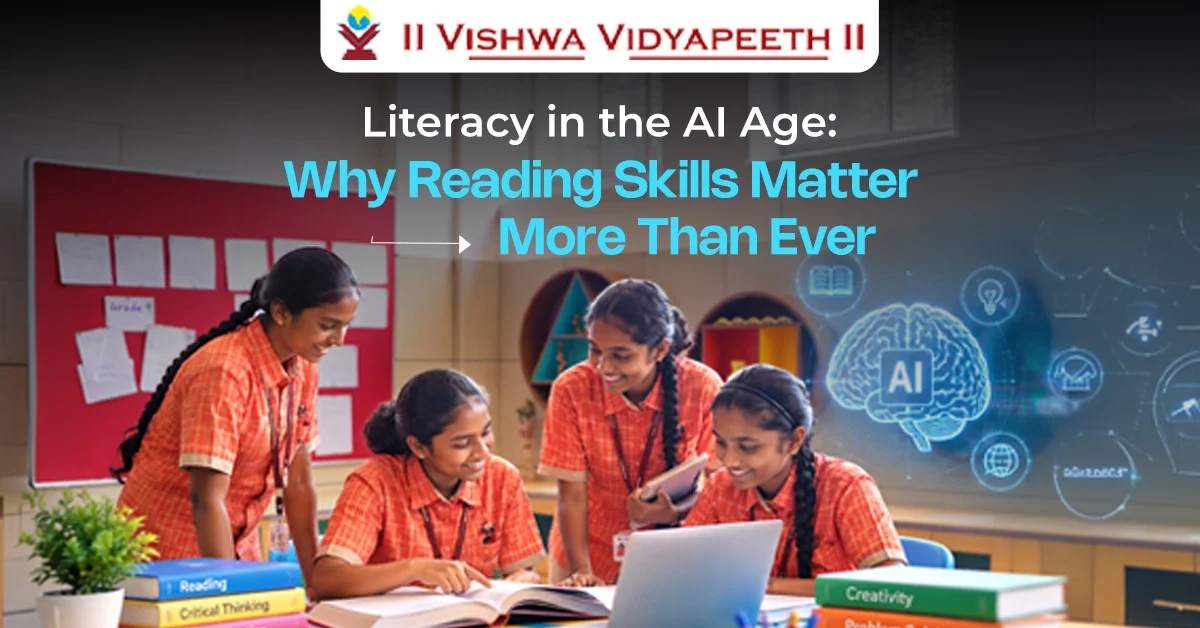
Literacy in the AI Age: Why Reading Skills Matter More Than Ever
AI has provided everything at the fingertips of children. Reading has reached an all-time low. Children don’t need to read complete texts to grasp a story, a concept, or an answer. So does that make reading irrelevant? Definitely not! Reading has a lot of benefits, and they still hold true in this AI age. It develops children’s ability to evaluate information, connect information across multiple sources, and think critically about what they read. We’ll dive deep into this matter and understand why reading skills for children matter more than ever.
What is the Meaning of Literacy in the Digital Age?
The meaning of literacy has evolved over recent times. Traditionally, literacy meant “the ability to read and write.” But there’s a deeper definition to this meaning. Reading literacy involves understanding, interpreting, evaluating, and reflecting on information.
Basically, children should be able to assess the reliability of the information and form their own opinions based on the information presented.
Importance of Reading Skills When AI Can Generate Answers
AI has relentlessly been blamed for generating hallucinations. It is the responsibility of the user to verify the information provided by the AI tool. And the ability to do that comes from reading (as we know). Accordingly, reading skills in the age of AI are not about discarding the use of AI, but learning how to differentiate between good and bad responses. Reading develops thinking, which should still be the foundation of all our interactions with AI.
Reading Is More Than Decoding Words
Real reading involves several layers.
| Understanding | What is the text saying? |
| Interpreting | What does the information mean? |
| Inferring | What can the child understand even though it is not directly stated? |
| Questioning | What should the child be asking about this information? |
| Evaluating | Is the claim supported by evidence? |
| Connecting | How does this information relate to something the child already knows? |
| Reflecting | What has the child learned, and has their understanding changed? |
The Problem With Reading Too Quickly
Today’s digital platforms are quick bursts of dopamine, with information coming through at fast intervals. Even when you haven’t processed one piece of information completely, the next swipe exposes you to another piece of information. There is nothing inherently wrong with it, but fast consumption shouldn’t become the only form of reading. When it does, students lose the ability to think deeply, and surface level becomes the new norm.
What Are the Most Important Reading Skills for Children?
| Early Years | Primary School | Middle School | Secondary School |
| Vocabulary | Identify the main idea | Compare multiple sources | Evaluate sources |
| Listening & oral language | Understand new words through context | Identify the author’s purpose | Interpret evidence |
| Sound Awareness | Summarise what they have read | Recognise assumptions | Understand complex arguments |
| Decoding | Make simple inferences | Distinguish evidence from opinion | Compare conflicting viewpoints |
| Reading fluency | Compare characters or ideas | Identify bias | Synthesise information |
| Story comprehension | Explain their answers | Interpret more complex texts | Conduct research |
| Sequencing | Support an answer with information from the text | Connect information from different subjects | Identify unsupported claims |
| Retelling | Read different forms of writing | Explain why they agree or disagree with an argument | Communicate conclusions clearly |
| Asking questions about stories | |||
For example, students from a secondary school in Varthur should incorporate reading as a tool for independent thinking.
Why Foundational Literacy Still Matters in an AI-Powered World
It is important to understand that all artificial intelligence is trained on human-generated data. If we start to rely solely on generated information, the production of new information starts to decline. It is important that we also teach children how to generate new ideas independently without inputs from an AI tool. The useful progression is:
Learn to read → Read to understand → Read to question → Read to evaluate → Read to think independently
What Can a School Do to Build Strong Readers?
A school can do a lot of things to build strong readers. In fact, top primary schools in Varthur Bangalore are already doing this:
- Build regular reading time
- Provide different kinds of texts
- Encourage discussion
- Let children ask questions
- Encourage children to explain
- Teach source evaluation
- Use technology purposefully
The Goal Isn’t to Keep Children Away From AI
AI is the new-age evolution in technology, and children shouldn’t be secluded from using it. However, there should be deep discussion on how children use AI. For example, we should expect the best primary school in Varthur not to instruct children to stop using AI, but to develop the ability to think and not lose out because of the easy availability of AI.
Final Thoughts
As a middle school in Varthur Bangalore, we are not against the use of AI. But responsible use and not losing the significance of reading is essential. AI may change how children access information. Strong reading skills will help determine what they do with it. That’s why literacy has still not lost its relevance. If anything, its importance has improved even more.
Frequently Asked Questions (FAQs)
Isn’t reading mainly important for language subjects?
No. Reading supports learning across science, mathematics, social science and research because students need to interpret instructions, evidence, explanations and problems.
If my child has good marks, are their reading skills automatically strong?
Not necessarily. A child may perform well on familiar academic tasks while still needing stronger skills in interpreting unfamiliar information, evaluating sources, or reading complex material.
How can parents improve reading skills in children?
Parents can encourage regular reading, allow children to choose age-appropriate material, discuss stories and articles with them, ask open-ended questions, and encourage them to explain ideas in their own words.